

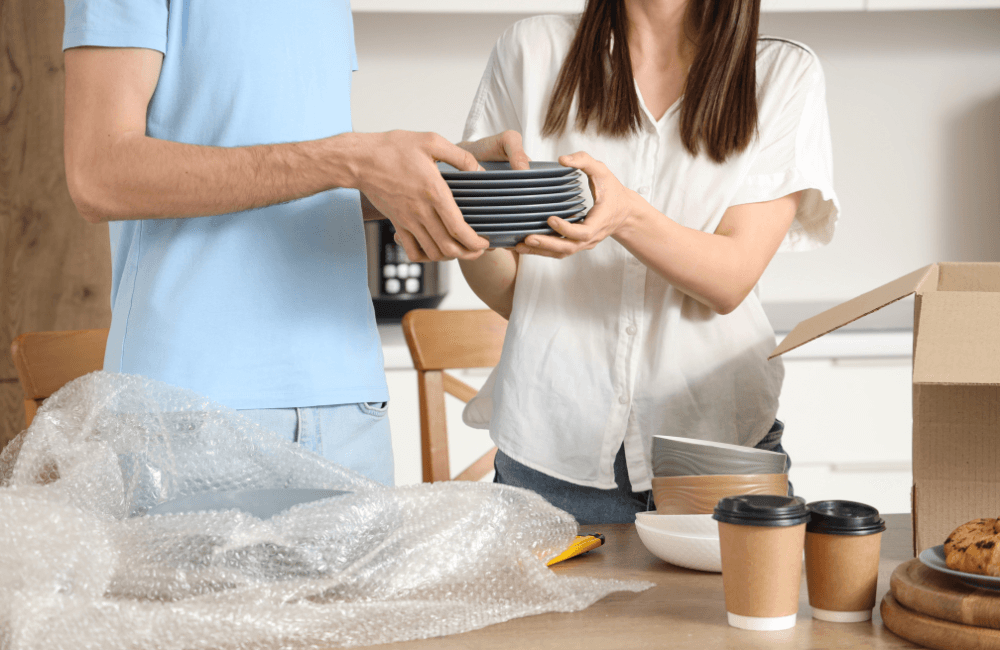
A kitchen might be quiet at night, with no clattering pans or boiling kettles, yet it holds the soul of a home. It’s where tea is poured during tearful conversations, where toast is made in early, sleepy mornings, and where laughter bounces off the tiles during family dinners. So when you close the door behind you on moving day, it’s not just the appliances and the crockery you’re taking — it’s memories, rituals, tiny joys. And that’s something worth protecting.
Of all the rooms we must prepare when moving house, the kitchen is often the most overwhelming. Not because it’s large — often it isn’t — but because of what it contains: hundreds of items, many delicate, others oddly shaped, some covered in memories. Plates that belonged to your grandmother, the chipped mug your child gave you for Christmas five years ago, glass jars you’ve collected almost by accident — things that don’t add up to much in money, but which speak loudly of your life.
A trusted London removals company understands this sentimental value. Packing these things safely can feel like trying to preserve shards of your own history. You want them wrapped gently, carried carefully, and unpacked intact at their new destination where, once again, bread will be buttered, soup will simmer, and life will go on.
Table of Contents
ToggleThe First Step Isn’t Packing
Before you reach for the boxes or bubble wrap, pause. The first step is to look. Open every cupboard. Pull out every drawer. Consider what each item means to you and whether it truly needs to come with you. This isn’t only about decluttering — although that can be useful — it’s about mindfulness.
We live in a world of accumulation. Too often, our kitchen shelves buckle under the weight of items we forgot we owned. There’s something incredibly liberating about choosing what to take and what to release. And this choice needn’t be rushed.
Give yourself an evening, maybe even a whole weekend. Lay out your utensils, dishes, and gadgets. Take them in. You’ll likely find a few mixing bowls you haven’t used in years, or perhaps seven different spatulas when two would do. Letting go of the excess is not wasteful; it’s making space — literally and figuratively — for what matters.
If you’re unsure where to begin or feeling overwhelmed, a professional packing services company London residents trust can help guide the process with care and efficiency. Perhaps think of it as curating rather than packing — a collection of the essential and the beloved.
This Is Not a Race
Moving house often feels like a deadline sprint, but it shouldn’t be. Especially when packing the kitchen. Rushing leads to broken things, and not just objects. Tempers fray. Moods shift. All because we’re trying to do too much in too little time.
If you can, begin with a calendar. Even if you’ve only a couple of weeks before the move, you can assign days to specific jobs. One evening might be just for wrapping plates. Another might be dedicated to labelling boxes. By spreading out the task, you reduce stress and increase the chances that everything arrives safe and in the same condition it left in.
Packing the kitchen is an exercise in patience and intention. Like cooking a stew, it’s better done slowly and with care.
Wrapping More Than Just Glass
We all know that glasses and china need extra attention. But sometimes the less obvious items are equally vulnerable. That old wooden spoon that’s worn smooth after years of soup-stirring? The enamel teapot with a cracked lid you use every Sunday? These aren’t just things. They’re part of the story.
So how do you wrap a memory?
Start with soft things. Tea towels and cloth napkins make wonderful padding for delicate items. That favourite jumper you don’t wear anymore is gentler than paper and more pliable than foam. It’s okay to get a little creative here.
Place glassware inside sturdy mugs if they fit. Nest bowls one inside another with cushioning between them. Remember, the goal is not only to avoid breakage but to prevent heartbreak. Every item should be treated as if someone else will be unpacking it with no idea of its value — which in a way, is true. Your future self will thank you for the extra five seconds it takes now.
The Box of Essential Things
There’s an odd phenomenon that happens on the first night in a new home. Even if you’ve labelled every box and know logically where things are, you still can’t find your kettle. And somehow, that missing kettle feels like the end of the world.
To avoid that panic, create a dedicated “first-night kitchen box.” In it, put:
– The kettle, obviously
– A couple of mugs
– Tea, coffee, and maybe hot chocolate
– A few forks and knives
– A pan or two
– A small bottle of washing-up liquid
– Paper towels or a dishcloth
– A tin opener (you’d be surprised how often this is forgotten)
– Something comforting to eat, like biscuits or soup
When everything else is in boxes and chaos reigns, this little collection of essentials will be your anchor. It represents the difference between a house and a home, between existing and living.
Boxes Are More Than Cardboard
Most people source their boxes from supermarkets or friends. That’s fine, to a point. But the humble box does a lot of work on moving day. It’s jostled, stacked, shifted again and again. If its base isn’t strong or its top flaps loose, it’s not up to the task.
And kitchen items are heavy. Dishes, pots, tins — it all adds up quickly. Using strong boxes is not an indulgence. It’s good sense.
Try not to overfill. A box should not be so heavy that you grimace when lifting it. Ten small boxes of manageable weight are better than five enormous ones that strain your back and risk everything inside.
And don’t forget to label. Not just “kitchen” — that’s a start. But specifics help. “Plates and bowls,” “Baking tools,” “Glassware — fragile.” When you arrive, you’ll be able to prioritise unpacking calmly rather than opening box after box in frustration.
The Hidden Joy of Labelling
There is something quietly delightful about writing words on a box. It is your future self speaking to your present self — a reminder of order in what feels like chaos.
Some find it helpful to colour-code labels, use printed tags, or even number boxes and write corresponding inventory lists. If that speaks to your sense of order, absolutely do it. If you prefer a thick marker and a sigh of relief when the word “FRAGILE” is scrawled in capital letters, that’s fine too.
What matters is clarity. Remember, moving day is loud and fast. Clear labels slow it all down. A box marked “Coffee Maker — For Morning Survival” is more likely to be opened first. And sometimes, a smile on moving day is powerful medicine.
Technology Is Not Always the Solution
We live in a world of digital everything. But in this task — wrapping, boxing, labelling — our hands guide us far better than any app. Packing a kitchen is a tactile affair. It’s about touch and memory.
Avoid overcomplicating it with checklists on your phone or dozens of digital reminders. You’ll likely end up holding a saucepan in one hand and fumbling for your password with the other.
Instead, keep a notebook. An old-fashioned notebook where you can scribble as you go. Draw a small sketch of how you’ve packed a box if you like. Jot a note to remind yourself where you tucked away the spice rack. It’s less efficient, perhaps, but so much more human.
And in the end, that’s what this whole process is about — something Removals Company Pro understands deeply, treating every move with the care and attention it deserves.
Let Others Help You
Some people find it hard to ask for help. If that’s you, consider this: humans are built for community. Packing up your kitchen isn’t a personal failing in need of hiding; it’s a life event. Invite friends. Make tea. Put some music on in the background.
What takes you five hours alone could take two hours with help. Even children can wrap cutlery or sort herbs. In fact, including them gives the move more meaning. It becomes something done together, a shared effort and memory.
Years later, you might not remember every box. But you’ll remember the conversation as you wrapped each plate, and that is worth so much more.
The Final Cup of Tea
When the last item is wrapped, the boxes stacked, and the cupboards bare, pause. Make one final cup of tea in your old kitchen. Sit. Look around. You’ll feel a mix of things: nostalgia, relief, excitement, perhaps a little sadness. All valid. All human.
Moving is about change, yes, but it’s also about continuity. That chipped mug, that favourite spoon — they come with you, bearing witness to your past and ready to play their part in your future.
The kitchen you’re leaving behind will live on, not just in memory, but in every meal you make in your new one.
And that — truly — is a kind of magic.